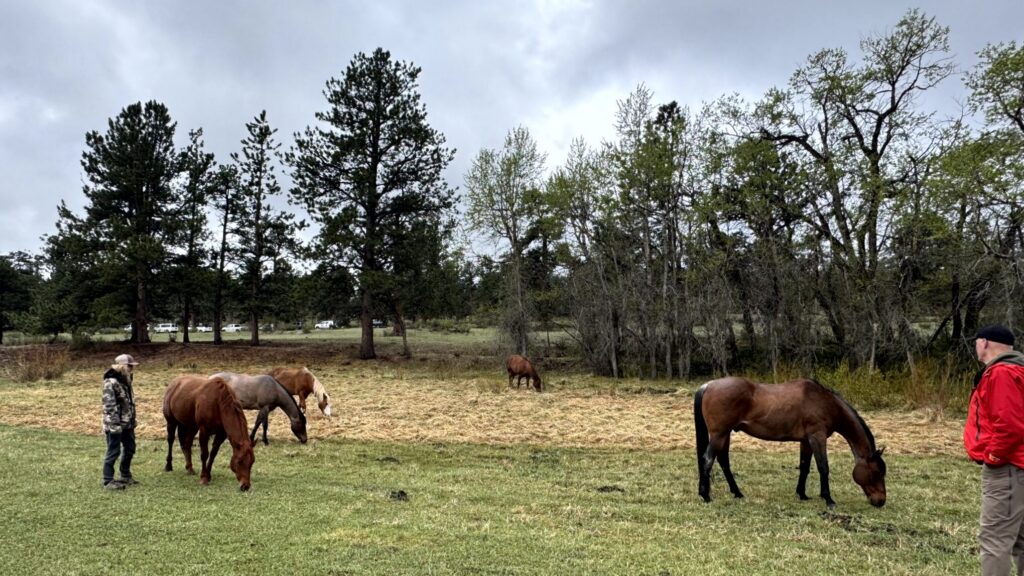
In May, Peaks to People Water Fund brought partners, practitioners, and community leaders together for a forest health and riverscape restoration tour at MacGregor Ranch in Estes Park as part of the Western Collaborative Conservation Network’s Confluence gathering.
Set against a beautiful mountain backdrop, the tour offered participants a firsthand look at how forest health, wildfire mitigation, watershed protection, and community engagement come together on the ground. MacGregor Ranch provided an ideal setting: a historic working ranch and conservation site where partners are advancing proactive, landscape-scale solutions to wildfire risk and watershed health challenges.

The MacGregor Ranch project is a powerful example of what becomes possible when partners align around shared priorities and coordinated action. Led by Larimer Conservation District, the 400-acre, multi-phase pre-fire forest health project demonstrates how cross-boundary collaboration, shared investment, and strong community relationships can move complex restoration work from planning to implementation.
Coordinated Action Across Boundaries
Throughout the afternoon, participants heard from a range of partners working across the Big Thompson watershed, including Colorado State Forest Service, MacGregor Ranch, Larimer Conservation District, Estes Valley Watershed Coalition, Estes Valley Fire Protection District, Larimer County Office of Emergency Management, and Peaks to People Water Fund. Together, these perspectives helped tell a larger story: wildfire resilience is not achieved by one project, one agency, or one landowner alone. It requires coordinated action across boundaries, jurisdictions, and areas of expertise.
Tour discussions highlighted the growing wildfire risk facing Larimer County and the importance of active forest management in reducing that risk before a fire occurs. Participants also explored the connection between healthy forests, resilient riverscapes, clean water, and downstream communities. In a watershed like the Big Thompson, where wildfire can quickly affect water supplies, infrastructure, habitat, recreation, and public safety, these connections are especially important.
The tour also emphasized the human side of restoration. Successful landscape-scale work depends not only on science and funding, but also on trust, communication, and community support. Field tours like this create space for partners and community leaders to ask questions, see treatments firsthand, and better understand the decisions, tradeoffs, and long-term benefits involved in forest and watershed restoration.
From Risk to Resilience
 For Peaks to People, this is where our role is especially important. We help bring the right partners together, align shared priorities, and sustain momentum so that collaborative ideas can become on-the-ground action. Through the Big Thompson Watershed Health Partnership and related efforts, we work alongside public agencies, local organizations, landowners, fire districts, water providers, and community leaders to advance projects that protect water supplies, reduce wildfire risk, and build long-term watershed resilience.
This tour was a reminder that collaboration is more than a meeting room concept. It is something that happens in the field, on working landscapes, and through relationships built over time. These conversations help strengthen the trust, understanding, and shared commitment needed to move landscape-scale work forward.
As wildfire risk continues to grow across Northern Colorado, projects like MacGregor Ranch show what resilience can look like in practice: partners working together, communities engaging in solutions, and restoration efforts designed to protect forests, rivers, water supplies, and people.
Peaks to People is proud to help convene and support this important work. Together, we are moving from risk to resilience—one partnership, one project, and one shared priority at a time.