
Across the West, land managers are in a race against time. Millions of acres of forests are overstocked, primed for severe wildfires that are growing larger and more destructive each year. Research shows that thinning followed by prescribed fire is the most effective treatment to restore forest health and reduce fire risk. But prescribed fire isn’t always an option—steep slopes limit access, homes and communities sit too close for comfort, and smoke in the air can trigger health and emotional concerns.
 When prescribed fire is off the table, thinning alone becomes the only viable path forward. But that leaves us with a pressing dilemma: what do we do with all the woody biomass?
The Biomass Challenge
Anyone who has driven through National Forest land in the Intermountain West has seen the result: endless piles of logs and slash waiting to be burned. While pile burning is common, it depends on narrow windows of cool, wet weather. As our climate warms and dries, those safe burn windows are shrinking. After a decade, piles often degrade to the point where they are unsafe to burn, leaving us with a landscape littered with flammable debris.
Other options come with trade-offs:
● Hauling logs and chips offsite can be expensive and logistically difficult, especially in Colorado where timber markets are limited.
● Lop and scatter spreads material across the forest floor, and while easier and much less expensive than removing felled trees, some argue it is less effective at reducing wildfire risk.
A recent Larimer County study on woody biomass, Rooted in Resilience, highlighted three major gaps that stand in the way of scaling solutions:
1. Infrastructure and capacity – limited roads, rough terrain, and few contractors.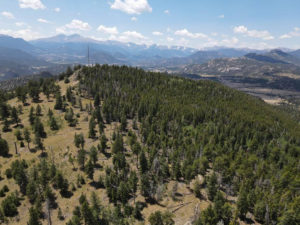
2. Markets for low-grade material – few outlets for slash and residue at scale.
3. Coordination – fragmented strategies make it hard to aggregate and move material cost-effectively.
With millions of acres needing treatment, it’s clear: there’s no silver bullet. Land managers need a full toolbox of options to address woody biomass.
Enter the Mushrooms: The Cold Fire Project
 What if we could recruit nature itself to help solve the biomass problem? That’s the premise of the Cold Fire Project, a collaboration of foresters and mycologists who are exploring the use of native fungi to break down woody material more quickly and safely.
Here’s how it works:
1. Slash and small trees are chipped into piles.
2. Locally harvested fungi—native wood-decomposers—are propagated in a lab and then introduced to the piles.
3. The fungi “eat” the chips, accelerating decomposition while holding more water and reducing flammability.
4. Within just 2–3 years, piles transform into nutrient-rich soil amendments rather than lingering fire hazards.
This approach not only reduces wildfire risk without producing smoke, but it also improves soils, captures carbon, and can even yield edible mushrooms. It’s a creative example of what one Coldfire researcher calls “ecology as technology.”
A Field Day in Estes Park
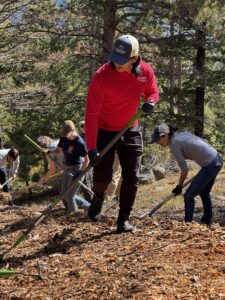
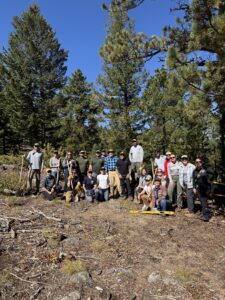
Last month, the Big Thompson Watershed Health Partnership coordinated a hands-on pile inoculation field day to showcase this promising method. Hosted by the Estes Valley Watershed Coalition in collaboration with the Coalition for the Upper South Platte (CUSP) and Coalitions & Collaboratives (COCO), the event brought land managers, fire mitigation specialists, volunteers, and curious community members together in the forest above Mary’s Lake in Estes Park.
Participants learned directly from Cold Fire researcher and forester Jeff Ravage, who guided the group through the inoculation process. After a short hike to thinning sites where piles had been chipped a year earlier, volunteers raked chips into symmetrical piles, measured their dimensions, and dug holes to consistent moisture levels. Into those holes went spores from locally sourced mushrooms that had been trained by the Cold Fire Project team to thrive on this specific woody material.
The work was practical, hands-on, and hopeful. Attendees left with dirty boots, new knowledge, and the excitement of knowing they’ll return next fall to check the progress of nature at work.
Building a Bigger Toolbox
Woody biomass is one of the thorniest challenges of modern forest management. No single solution will do the job. Pile burning, chipping, hauling, lop-and-scatter, and now fungal inoculation each have a place, with their own benefits and limitations. What’s clear is that land managers need a full and flexible toolbox, supported by community partnerships, creative thinking, and collaborative action.
The Cold Fire Project and the field day in Estes Park demonstrate just how powerful that toolbox can be when we’re willing to innovate and learn from nature. With wildfire risk rising and our forests under stress, expanding that toolbox is more important than ever.